Engraving and Carving Antler – Orca Knife

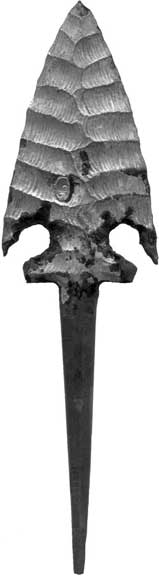
Here’s my latest knife. It’s a tiny deer antler Orca done in NW Native American style.Orca_Knife_Group_2Web Orca_Knife_Group_1Web

The knife is 3 3/16 inches overall, with a 1 1/4 inch long 1075 carbon steel through-tang blade. The antler has been aged with potassium permanganate. The handle is made from the last fork of a really old (and tiny) naturally-shed antler.

I’ve been experimenting with engraving and carving antler lately, and have come up with a combination of engraving the edges/outlines with a Lindsay template onglette, carving out the background spaces with NSK and carbide burs, followed by some special little scrapers I’ve made. Tiny flats help on occasion as well. Seems to work fairly well. You do need to take fairly light repeated cuts with the onglette, or the surface of the antler can tear.

I was sort of surprised, because under the microscope carving antler at this tiny scale reminds me very much of carving ivory soap! What seems hard and unyielding with a standard knife is gentle and easy with tiny tools.

Thanks for looking!

Tom


Posted in Carving, Engraved Knife, Knapped Knife, Netsuke, Uncategorized | Tagged , , , , , | 2 Comments

Press-Forming Adventures Part 6

Hummingbird_Skull_Press_Form_35
Above are all of the hummingbird and owl press forming works I’ve been working on…an interesting ride, I must say.

Hummingbird_Skull_Press_Form_22
Hummingbird_Skull_Press_Form_19
Hummingbird_Skull_Press_Form_20
Above is the completed silver hummingbird skull and titanium pendant, with leather neck cord.

Available soon at BladeGallery.com

Below are images of a Hummingbird Medicine Pouch.  This one is for the August fundraising auction of my local knapping group (stone tool making).  All the ladies I’ve shown this one to have seemed to like it!  It’s made from copper, naturally shed elk and deer antler, and buckskin.

By the way, you can find a complete (and free!) tutorial on making buckskin pouches just like these in my Resources section.  Here’s a handy link to take you right to it!  Making Buckskin Pouches…

Hummingbird_Skull_Press_Form_25
Copper press formed and chased skull, on carved naturally-shed elk antler.  I’ll tie the skull onto the antler with waxed linen thread.

Hummingbird_Skull_Press_Form_28Hummingbird_Skull_Press_Form_29Hummingbird_Skull_Press_Form_30 Hummingbird_Skull_Press_Form_31
The first Hummingbird Skull pouch met with such aclaim that I had to do another to go to BladeGallery.com  – available there soon.  On this pouch, I’ve used a naturally-shed deer antler for the toggle catch, and carved a Northwest Native American-style orca on it.

Hummingbird_Skull_Press_Form_32 Hummingbird_Skull_Press_Form_33 Hummingbird_Skull_Press_Form_34

Thanks for looking!

Posted in Carving, Jewelry, Pendant, Press Forming, Steampunk | Tagged , , , , , , , , | 2 Comments

Press-Forming Adventures Part 5

Today I’m working on making a pendant from the little silver hummingbird skull I press formed during our last visit.  I’m engraving a piece of Grade 2 titanium for the back of the pendant.  I’m hoping the gray color of the titanium will coordinate nicely with the bright silver color of the hummingbird skull.


In the above two images, I’ve completed engraving one side of the feather layout, and excavated the void that the hummingbird skull will sit in.


Here, you can see the holes I’ve drilled in the titanium plate for some silver wire staples to hold the hummingbird skull on with.  Normally, I would use solder as well, but I know of no way to solder titanium.  You can weld titanium with a very expensive jewellry welder, but I don’t have access to one of those…

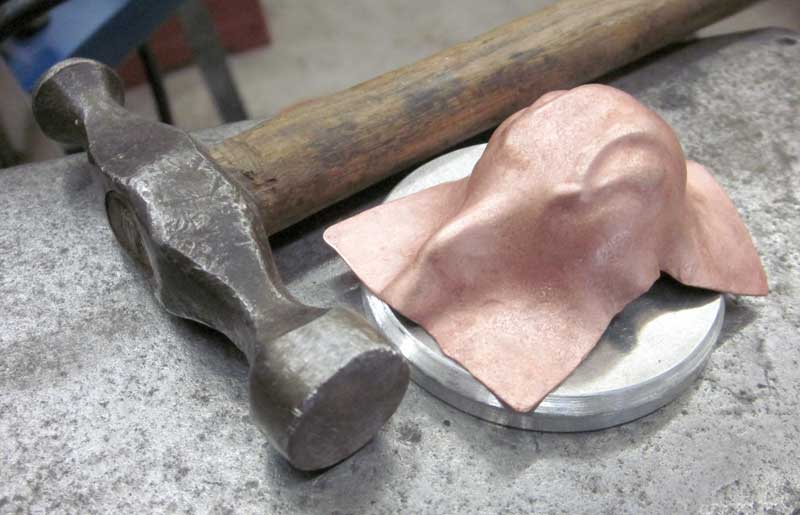
I’ve also played around with press forming copper sheet around a small beach rock.  With the raven skull I made from shortening the beak of a pressed hummingbird skull, I’ve created a Northwest-style raven fetish of a local Puget Sound Native American creation legend.

Here’s the story:  In the beginning, Raven lived in the spirit world, but one day he carried a rock away over the sea.  When Raven dropped the stone into the water,  it swelled and swelled, becoming the land we know today.

Posted in Carving, Jewelry, Netsuke, Pendant, Press Forming, Steampunk | Tagged , , , , , , , | Leave a comment

Press-Forming Adventures Part 4

Well, the owl worked out so well, I decided a hummingbird was in order.  If you recall the “encouraging failure” from the first post in this series, I used the copper sheet pressing from that to chase a small hummingbird skull.  That became the model for a press die.


The original “encouraging failure,” above.


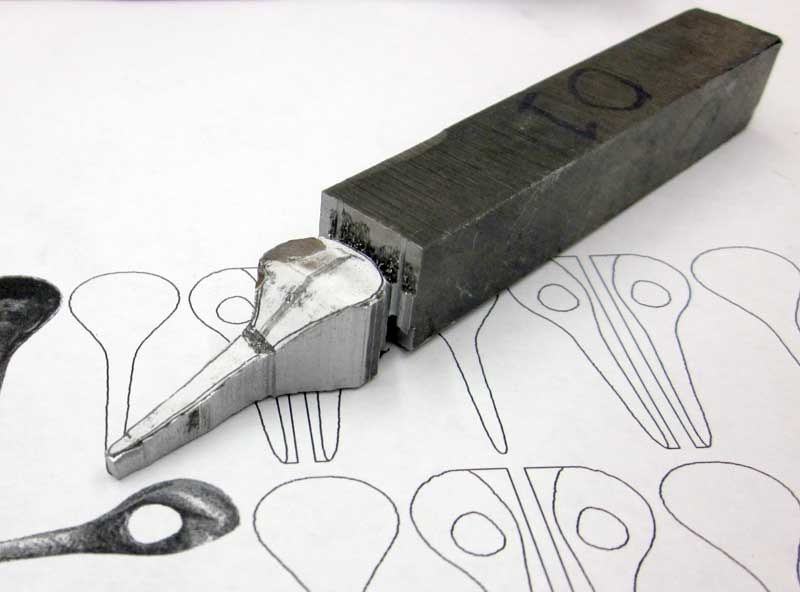
Above, I’ve begun cutting out the hummingbird press die from a 5/8 x 5/8 inch square piece of O-1 carbon steel I normally use for making my knives.  Why O-1 and not mild steel?  I had it on hand and it was the right size.  No other reason…


The above two images are of the finished press die and the original “encouraging failure” hummingbird skull.  Note that I’ve drilled and tapped a 10-32 hole through the skull of the press die, before I cut out the profiles of the hummingbird skull.  That will hold the skull securely to the “pusher” I’ll turn from aluminum.


Above is the first copper sheet pressing on the die.  Since this is a considerably smaller die than the owl skull, it only took three pressings to get this far rather than the four it took for the owl.


Above, the completed die and the completed first pressing.


There’s been a little madness to my method here.  Above, I’ve made another pressing and am going to shorten the beak to make a tiny raven skull.  If you think about it, this partially-formed hummingbird skull shape is pretty generic for a lot of different birds, if you ignore the long beak.  You can also see the specialty pitch block I made up for this press die as well.

By the way, I made the press die extra tall just for this reason.  There are a lot of different bird skull this basic form will be appropriate for, saving me a bit of labor making different press dies.


The above two images show the press die, a normal pressing and the finished raven skull.

Above, I’ve completed a copper humming bird skull and a silver version as well.  Now to make a pendant from the silver one.  I don’t know what the copper one will become yet.

I guess I should also tell you that after cutting the hummingbird skull free from the metal sheet, I take it to the anvil and carefully forge the open bottom of the beak closed on the anvil, with a tiny hammer.  Picture a tapered tube, with overlapping bottom edge.  Note that I don’t do that for the raven-style beak.

Thanks for looking!

Posted in Carving, Jewelry, Pendant, Press Forming, Steampunk | Tagged , , , , , | Leave a comment

Press-Forming Adventures Part 3


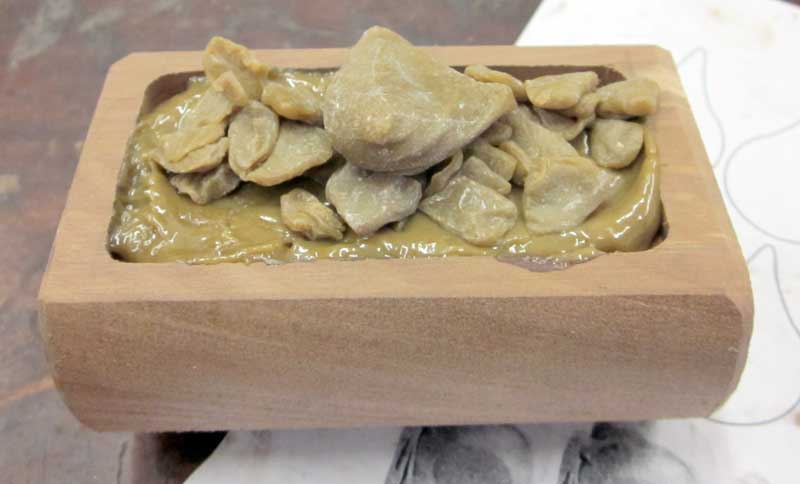
Now it’s time to begin the finishing process.  I’m going to be “chasing” the final details here, so will be filling and embedding the copper piece in pitch.  But, since I intend to use my Lindsay Airgraver in the chasing process, I’ll need a fixture I can place in my engraver’s vise under the microscope.  To facilitate that, I’ve turned a hardwood cylinder (about three inches in diameter) and excavated a pocket for the pitch.  You can see some small pieces of pitch in the background.  I get my pitch from Northwest Pitchworks.


Above, I’ve begun filling the pocket with pitch.  I’ve already melted a layer of pitch in the bottom, and am adding more for the next layer.  I’m using a heat gun to melt the pitch, but a soft “bushy” flame from a plumber’s torch would work just fine as well.


Above is my copper piece mounted in the hardwood cylinder, and clamped in my engraver’s vise.  The cylinder is important here because it allows the piece to be rotated in the engraver’s vise and held very securely.  You can purchase similar inexpensive wood fixtures here.


Here is the hardwood cylinder and copper piece mounted in my engraver’s vise.


Here I’ve penciled in the details I’ll be chasing in.


Above, I’ve begun chasing around the bone eye ring.  I’m using a 90 degree “liner” I made, in my Lindsay NitroG20 Airgraver.


Above, you can see the 90 degree “liner” and a magnified view in the inset image.  I made this from hardened 1/8 inch diameter piano wire.  At this scale, I need the business end to be smooth, but not necessarily polished.


Above, I’ve finished chasing in the bone eye ring edges, and textured the inner area with a simple hardened piano wire punch.  Notice I’ve also been further refining the shape of the tip of the beak as well.


Above, I’ve used my NSK micromotor and carbide burs to carve out the center eye circle.  You can see the little copper plug I removed lying nearby.  I found it was much easier (for me, at least) to carve the skull free from the waste copper than to try and hold it at the many odd angles it would take to cut it free with a jeweler’s saw.  But, that might just be a personal problem…


Above is the other side, and I’ve also begun carving away the base of the skull.  You can see the two sizes of carbide burs I’ve used.  I found the smaller one worked much better in close quarters like the tip of the beak.


Above several images, other views of the same.


Above, I’ve used a small torch to heat the copper and get it to release from the pitch.  I don’t want to heat the pitch too deeply here, since I’m going to want to use this same fixture and pitch for the other owl skulls…


Here’s the finished skull after cleaning it up with abrasives and files, along with an unfinished version.


Above, the finished skull after patinating, but before polishing the surface back a little with 0000 steel wool.


Above, a beauty shot of the entire process, start to finish!


And, finally, the finished version.


Here’s the finished pendant.

Thanks for looking!

Posted in Carving, Jewelry, Pendant, Press Forming, Steampunk | Tagged , , , , , | Leave a comment

Press-Forming Adventures Part 2


Above is the finished press die installed on a 1/4 inch thick aluminum disk (bolted on utilizing the hole I drilled and tapped on the bottom of the steel owl skull form).  The copper piece in the center is the first failed attempt at pressing copper sheet.  You can see the copper decided to fold along the edges, so I had to figure out something to do about that.  The copper piece on the right side is the next attempt, which was successful after I figured out what to do about the folding problem.


And a view from the bottom.


I also changed from cutting out a 2 inch diameter circle of copper sheet to using larger rectangles.  Easier cutting, and with less critical issues getting the press die centered in the middle of the metal, fewer gaps.  Note the red center line I’ve drawn on the fully annealed rectangular sheet to help centering the die in the press.  By the way, there’s nothing special about this sheet of copper – it’s just an inexpensive 18 gauge sheet from the hobby metal display at my local Ace hardware store.


Above, I’ve placed the urethane container, sheet metal and press die in my little hydraulic press.  I’ve slowlyy raised the ram until all the parts are in contact with each other, then carefully centered everything.  I’ve also made certain the parts are directly above the hydraulic ram.  I don’t want anything to get caddywhompus, because that might cause something to be ejected at high velocity – I value all of my parts and would prefer not to be injured!  By the way, proper safety equipment like eye protection is a must here!  Here’s a link to a build-along of a press similar to mine.

Above, I’ve begun squishing the die down into the urethane.  You can see the copper is beginning to take the shape of the die, and starting to fold along the edge.  It is this folding we need to watch carefully, and take action to correct before going too far.

Here is about as far as you want the folds to go.  Much more than this, and it might not be possible to correct the problem for the next pressing.

Above, I’ve removed the die from the press.  The folds on the left side (bottom of the image) are almost too far gone.  I had to do a little fancy planishing to hammer them out.  Don’t let them get this bad!

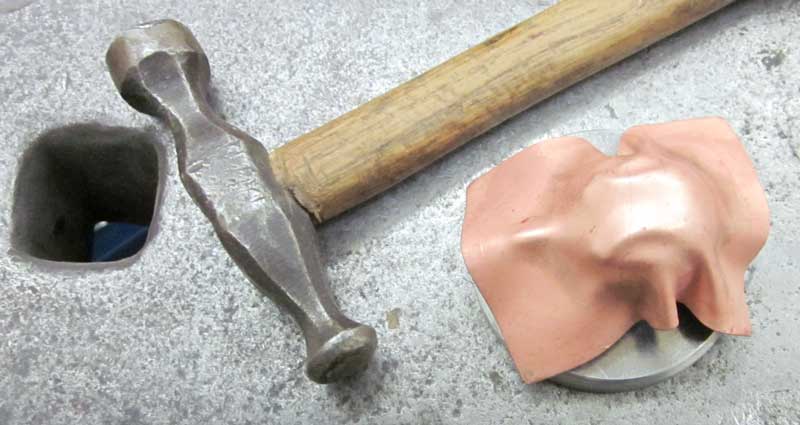
Above is how to fix the fold problem.  I’m using the horn of my anvil as a planishing stake and gently hammering on the “up” side of the fold (the top of the hill).  In this case, you can see there are two “up” folds here.


Above, I’ve completed planishing (hammering) the two “up” folds flat, and need to do the other side.  Hopefully, you can see the cup I’m beginning to form on the planished/hammered side.  I want this area to be in a cupped shape, and not back to plain flat sheet.  This will help with the pressing, reducing fold formation a bit.  However, you don’t want this to be so deep of a cup that the copper sheet will hit the press top before the aluminum base of the die does.

Here, I’ve planished both sides, ready to be fully annealed and pickled before the next pressing.

Above is the second pressing, ready to planish away the new folds.


And, here is a view of the second pressing from the bottom side.

Above, I’ve planished all the folds away.  Notice this time I’ve begun planishing the end of the beak as well.  Notice the cup forming, and how the edges of the copper sheet are no longer straight.  The edges are being pulled in towards the areas where the most deformation is occurring.  This is a good sign, because it means the copper isn’t being stretched and thinned too much by the pressing.

Here is the fully planished piece, ready for annealing, pickling and the third pressing.

And, above, is the third pressing.


Planished, ready for ready for annealing, pickling and the fourth (and final) pressing.

The third pressing and planishing, from another angle.

Above, the fourth and final pressing.  My copper sheet rectangle was a little narrow, or I didn’t get it quite centered.  This side is a little short, but still usable.  By the way, I made my steel owl skull form a bit taller (top to bottom) than the finished piece will be, just to accommodate problems like this.

A view from the right side.


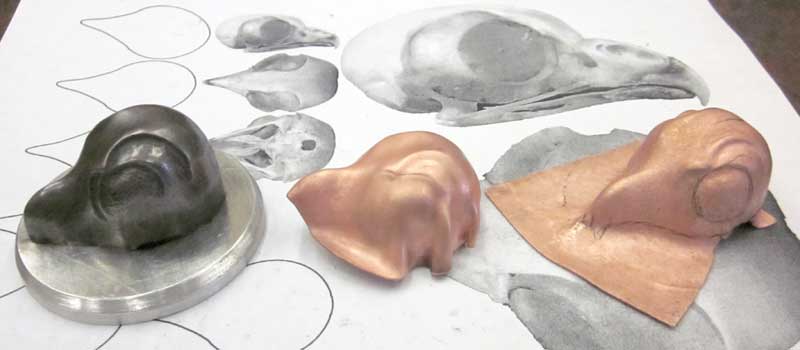
Above are the failed original and the three successful pressings.  You can see the high degree of repeatability in the process.  The skull in the upper right is the one we’ve been working on in this posting.

Posted in Carving, Engraved Knife, Floating Treasure, Jewelry, Press Forming | Tagged , , , , , | 4 Comments

Press-Forming Adventures Part 1

Above images courtesy of BladeGallery.com

And a work-in-progress image of my own.

In the past I’ve experimented with carving bird skulls from antler, and some with small helmets.  While they proved popular, all of the above works were terribly labor intensive.  While stumbling around the Internet, I found some videos from Rio Grande jewelry supply showing the Bonny Doon Press in operation.  This started ideas rolling around in my noggin, and a little more research led me to PotterUSA.com and their inexpensive jewelry presses and contained urethane.  Since I already have a small 20 ton hydraulic press I use for bladesmithing, that added fuel to the fire, and here we are.  Here’s a little hint – since many bladesmiths have a hydraulic press for forging, they might take note that this process could easily be adapted to create silhouette dies that could be used to make metal halves of sheaths.  Here’s a pretty decent video about silhouette dies by Melissa Muir – bladesmiths take note of the possibilities…


Above is my (semi) finished first success.  It was a bit of a winding road, but I seem to have broken at least some of the code.  I can now make multiples of this design, with maybe 70% less work for each.  Here’s how I got there…


Above is my first attempt, something I think of as an encouraging failure.  I carved a positive bird skull shape in walnut (grain oriented vertically) and glued it onto a 2 inch diameter, 1 inch thick circle of walnut (grain oriented horizontally).  The press squashed it like a soft rubber hockey puck.  But, the small sheet of copper I used was partially shaped well enough to encourage me to make a metal die.

I decided on an owl skull, since my contained urethane is only 2 inches in diameter, and owl skulls are round rather than long.  I figured I could make a pressing large enough to make a pendant sized piece.


Here is my pattern and research material.


Above is the beginning of the owl skull form, sawed from a 1 x 1 inch square mild steel bar.  You can also see my PotterUSA contained urethane in this image.  This little plug of urethane is quite hard, I’m unable to dent it with my finger, but it will serve as the resistance medium to form thin copper sheet around the owl skull form.


Here’s one side partly ground with an angle grinder.  I’m leaving the skull attached to the bar to help hold this slippery little thing…


I’ve drilled an tapped a hole in the bottom to hold the skull onto a metal plate during pressing.


Partly ground – note the center line I’ve drawn on with Sharpie permanent marker to try and keep both sides identical.  I often use red Sharpie because it doesn’t show blood as easily…


More grinding and a few features drawn in.


This is as far as I can go with the angle grinder.


Above, another center line and additional features.


Here I’ve begun adding inthe eyes with my NSK micromotor and carbide burrs.  Note that I’m not carving anything below the halfway mark – if I carve there, the urethane will force copper into the concave spaces, trapping my form after pressing.  That would probably cause damage to either the copper sheet or the form itself trying to remove the pressing.

The other side – same story, different day…


Things smoothed out some…


Above, I’m using a small drum sander to finesse the shape and smooth the surface.


Now I’ve cut the skull from the steel bar, ready to file and grind the back side.


The above two images – using coarse ScotchBrite™ and jewelers files to refine and smooth everything.  I want the form to be smooth, but I don’t think it needs to be polished.


The above two images, the finished form left and right sides.

Posted in Carving, Jewelry, Pendant, Press Forming, Steampunk | Tagged , , , , , | 4 Comments

Mammoth Ivory and Stone Knife

Well, while I was on a roll with the knapped steel knife, I got a wild hair to make a miniature stone bladed knife.  I had a few chips of lovely chalcedony I collected from what I call “The Nevada Death March.”  This came from an old mining site about 60 miles east of Battle Mountain, Nevada.  Not a soul in site, on the top of a small mountain, and the only place in the world I’ve ever been (and that’s saying a lot!) where there wasn’t a light in sight in any direction.  And I could see for about 30-40 miles in any direction.


I decided to base the design on a stone age sculpture I’ve always liked, from the Lepenski Vir site in Serbia.  She is often called the “Fish Goddess,” but she strikes me more as a Sheela na gig from the UK or Ireland.


Here’s my take on a knife design, with the naughty bits left off.  I chose to use fossil mammoth ivory for the handle.


And above is the design of the petroglyphs on the front and back sides.  These are based (loosely!) on petroglyph styles from the painted caves of France, the American Southwest, and Australian aboriginal rock paintings.

And, above are the final results, with an elk antler and walnut presentation box.  The blade is held in with charcoal and pitch (an ancient stone age recipe), and artificial sinew wrappings.  I went with artificial sinew, rather than actual sinew, because the tiny dust mites in the house will render real sinew into dust in just a few years.

Available soon at BladeGallery.com

Thanks for Looking!


Posted in Carving, Engraved Knife, Knapped Knife | Tagged , , , , , , | Leave a comment

Knapped Steel Petroglyph Knife

Another of my signature “Knapped Steel” knives.  I had so much fun playing with the antler and potassium permanganate from you kagamibuta adventure, I decided to make a knife handle.

Above is the knife I “carved” prior to heat treatment.  I use a scan like this to design (on paper) a pleasing shaped handle.


Here is the moose antler handle, completely fabricated and ready to color in the potassium permanganate bath, just like we did in the kagamibuta adventure.


Here is the antler handle after the first hot bath of potassium permanganate.  I’ll remove most of the color at this stage, and do repeated baths.  Lather, rinse, repeat as necessary.


The handle colored, and ready to install the blade.


And, above, the results of the last trip in the hot potassium permanganate bath.  I’ll remove more of this for the final coloring of the handle, ready to engrave some petroglyphs on.  I call this “engraving” rather than scrimshaw.  Scrimshawing doesn’t remove material from the surface of the ivory/antler or whatever material is being used, while engraving does.  Hence the difference.  Anyway, that’s my story and I’m sticking to it.


Above, I’ve engraved the lines for my petroglyphs, and “painted” concentrated potassium permanganate into the grooves.  I use a very tiny synthetic artist’s paintbrush for this, and will repeat “filling the ditches” with the potassium permanganate solution several times to build up the depth of color I want.  By the way, I also use a tiny bit of TSP (tri-sodium phosphate, or washing soda) in the solution as a wetting agent.  It seems to help.  In the sun petroglyph above, you can see some of the purple potassium permanganate in the grooves, before it has oxidized the antler.  A few minutes later, and the color will be dark brown.


I also cheat a little, and the final application is a little brown ink.


Above is the final appearance of the petroglyphs after a vigorous application of steel wool to smooth everything out.


And, the final knife after I made a walnut display box.

Available soon at BladeGallery.com

Thanks for Looking!

Posted in Engraved Knife, Knapped Knife | Tagged , , , , , , | Leave a comment

Making a Kagamibuta Netsuke Bowl Part 4

Now it’s time to color our antler kagamibuta bowl.  I’ll be soaking the antler first in a hot, but relatively weak solution of potassium permanganate (KMnO4), then polishing to remove much of the color.  I’ll repeat this a number of times until I’m satisfied with the color, and, in this case, will follow up with a hot solution of yellow fabric dye to “warm” up the color.

Potassium permanganate, while a garish purple color in water, is NOT a dye.  It is, instead, a heavy oxidiser.  When it first colors the antler, it will appear a horrible purple, but will quickly turn to various shades of brown, eventually aging overnight to almost black in the porous areas of the antler.  This is highly dependent on how much soaks in, hence the repeated soakings and polishings.  When I’m finished with the process, I’m hoping this will end up looking like old antler netsuke, by simulating the aging process.

As natural materials age, they typically darken due to oxidation.  There are two main sources of age oxidation – oxygen in the atmosphere and light.  Both of those are oxidising agents.  Potassium permanganate does exactly the same thing, just far more quickly.


Above is my double boiler contraption.  It is just a thrift store pot and a glass jar.  Do be smart here and NOT use the best pots and pans of She Who Must Be Obeyed, or you’ll end up in the doghouse.  Don’t ask how I know this.  I’ve warned you, so if Momma gets mad at you, it’s your own damn fault!  Also, potassium permanganate IS a powerful oxidiser, and you should not mix it with anything but water.  Don’t drink it.  Yes, it will stain damn near anything it gets on.  It will attack metal, so use a glass jar, not metal.  We are using it with boiling or near boiling water, so do not use plastic containers.  Things will be HOT, so don’t burn yourself.

This is about 1/24th of a teaspoon (approx. 1/3 of a 1/8th teaspoon measure) of potassium permanganate in 100 ml of water.


Here’s the antler bowl after about a minute of soaking in the hot potassium permanganate solution.  I’ve used a piece of string tied to a button for convenience so I can pull the bowl out of the solution periodically, dry it off, and polish most of the color away.  Obviously, the harder areas of the antler will absorb less of the solution (and be lighter in color), and the more porous areas will absorb more (and end up darker in color).

I find I like using my Foredom flex shat grinder and ScotchBrite™ pads to remove the outside layer of color (I like the purple colored stuff best for this), but really fine sandpaper followed by buffing with jeweler’s abrasive compounds will work.  I would NOT use colored polishing compounds since the grit will end up in the pores of the antler and undesirably tint the antler.  I have a white polishing compound that I like.


Above are a series of images of the antler bowl after soaking, along with a set after polishing so you can get an idea of how the coloring process goes.  Each set has the bowl as it appears right out of the hot solution (dry), followed by a set after polishing.  Each set is separated by a blue outline.  The last set in the blue box is after the hot yellow fabric dye.  All together, I did about six trips in the potassium permanganate (about 5 minutes each time), and one 5 minute soak in the yellow dye.

The colored bowl with the lid.  Now to let it sit for several days to dry COMPLETELY, then I’ll apply a final finish.  Since I’m concerned about humidity changes (since the original ivory bowl cracked), I’ll apply a nitrocellulose lacquer finish in the hopes of eliminating at least some of the humidity sensitivity.


I’m going to use my incredibly “high tech” setup to help the nitrocellulose lacquer penetrate a bit better, at least into the more porous areas.  Above are the components I use – basically a large glass jar (that seals well), a hand vacuum pump, and a smaller glass jar holding the liquid lacquer.  I thinned the lacquer with lacquer thinner, somewhere between 2 parts lacquer to 1 part thinner and 1 to 1.  I just need the liquid to be a bit thinner than it comes from the can.


Above I’ve sealed the unit (the bowl is in the liquid – make sure it submerges completely) and pumped a vacuum to about 20 inches of mercury.  I’ll leave the bowl in the liquid under vacuum for about an hour, then release the vacuum and leave the bowl in the lacquer for at least another hour.  The vacuum only removes air from the porous areas of the bowl, then ambient air pressure (about 30 inches of mercury positive pressure) will force the liquid in.  The removed air will help suck the liquid into the porous areas of the antler.  The vacuum is only PART of the equation…


Above, you can see a little foam on the surface of the liquid.  Some of this is air from the antler, and some is evolved air and vapor from the solvent.   Since my system isn’t terribly tight, during the hour of vacuum I’ll pump from time to time to restore the vacuum to 20 inches of mercury.


Above are top and bottom views of the finished kagamibuta netsuke bowl, after allowing the lacquer to cure for several days.


and here is the finished bowl with the lovely Katsunori shakudo (gold and copper Japanese art alloy) plate, installed at last.  You can see more of this netsuke here at Roger Rudolph’s web site:  http://ajiarchives.com/pictures.aspx?category=Katsunori


Thanks for looking!
Posted in Netsuke | Tagged , , , | Leave a comment