Clockwork Trilobite – Part 2

Today was just a lot of sawing.  A lot…I had forgotten how gummy and resisting sterling silver could be, especially in thicker pieces.  Now I remember why I much prefer sawing, engraving and carving in steel…

Clockwork_Trilobite_Pendant_13a
Above are the two trilobite pieces sawn from my two silver plates.  On the left is the top half of the trilobite (and the thickest part) and on the right is the bottom part (the thinner plate).

As you can see, there’s a fair amount of scrap that isn’t useable for much of anything else.  The largest scrap part of the thinner plate (on the right) is still useful, and perhaps the next smaller might eventually find a use, but the small half-moon is only good for silver reclamation without a lot of additional work.  One day, years from now when I have several pounds of scrap, I can send it back to a refiner for the scrap value.  Remelting at this point would remove so much of the alloying copper as oxide scale, slag and pickling depletion, that I couldn’t ethically (or legally…) claim it to be sterling silver without assaying the silver and correcting the alloy.  I doubt I’ll ever find use for the scraps of the thicker (on the left), they’re just too small, but that is the nature of this endeavor.  They may eventually find their way into a little shibuichi (I occasionally alloy and roll my own).

Now to cut out the gears.  The client has requested copper gears for a contrasting color, but in a fortunate turn of events, I discovered a small piece of shibuichi in the scrap drawer.  Shibuichi is a Japanese art alloy consisting of copper and silver, usually one fourth silver (shibuichi means one fourth in Japanese).  This happens to be 25% shibuichi, the standard alloy, and was a test piece for this knife:Clockwork_Trilobite_Pendant_13b
The knife scales are patinated shibuichi, which normally turns a dark grey, where copper would more often be blacker.  Shibuichi is a much more exciting metal than copper, so will lend additional interest to the piece.  Shibuichi when freshly polished has a loverly pinky/coppery color, but like copper rapidly oxidizes darker.  So, I’ll cut the gears from the shibuichi.

Toadsticker_Shiv_Box
Above is a closeup of the little knife box, for Dori.  Hope this helps, Dori!

Clockwork_Trilobite_Pendant_13a
Above is the paper pattern glued to the shibuichi.  I will cut it a little large on the left side, as I intend to undercut the silver top to make the gears appear as if they disappear inside the trilobite.

Clockwork_Trilobite_Pendant_18
So, after several broken jeweler’s saw blades (I was something of a klutz today), and a few bad words, you can see all the parts above (minus one  other small gear).  As a technical note, I used 5/0 for the shibuichi and thinner silver plate, and 2/0s for the thicker.

Here’s what I tell clients about maintaining the gear color on the trilobite:  Both copper and shibuichi (and bronze, for that matter) will rapidly oxidize to a dark color from the more desirable coppery color.  There isn’t any coating known to man that will stop this for long, and things like lacquer will just chip and break down leaving that mottled, nasty look after a few years.  So, eventually when the gears turn darker than you like, your mission is to use a “Pink Pearl” pencil eraser and gently rub the dark areas to remove the oxides and restore the coppery color.  I’m sure you remember sitting in history or math class and making an old penny go back to shiny copper with a pencil eraser?  Do this gently – you don’t want to remove so much that the gears look like new copper (or shibuichi in this case), so stop when it gets back to looking good – we need the dark in the recesses to see the lighter coppery color.  Of course, if you remove too much, a month or so will self-heal the problem.  “Pink Pearl” is a brand name for the common pink colored eraser that almost all pencils have, so a new pencil eraser will work fine, just be careful not to let the metal rim scratch the shibuichi.  Don’t use an ink eraser, that is way too abrasive.

Next, I have to flatten the mating surfaces of the top and bottom plates, and then carve out the undercutting recess for the gears in the top plate, all before silver soldering everything together.

Posted in Carving, Pendant, Steampunk | Tagged , , , , , , | 2 Comments

Clockwork Trilobite – Part 1

Here’s the start of a commission for an engraved and carved silver trilobite, with copper gears.

Clockwork_Trilobite_Pendant_1
Above, I’m weighing out scrap sterling silver (looking for about an ounce).  The scrap needs to be clean, and free of any solder.  If it has been melted a couple of times, you probably shouldn’t use it without deoxidizers in the melt.

Clockwork_Trilobite_Pendant_2
Above is my setup for melting the silver, and casting a small ingot.  The steel ingot mold needs  to be heavily smoked so the molten silver doesn’t solder itself to the mold – I use the smoky acetylene-only (no oxygen) flame for the smoke – you can see the heavy black smoke in the image.  Don’t do this inside the studio – the fluffy and filthy black carbon from the smoke will settle on and in everything!

Clockwork_Trilobite_Pendant_4
Here’s the cast ingot, shown inside the mold.  Don’t touch, it’s still really hot!

Clockwork_Trilobite_Pendant_6
Here’s the final weight for the ingot.  There’s always loss in the melting and casting process.  There’s even more in the engraving and carving afterwards – lots ends up as fine dust that really can’t be recovered, and the other little recovered bits must go back to a refiner before it is really useful again.  Bummer, because silver is becoming pretty expensive!  After this, there are a fair number of trips through the rolling mill, along with multiple annealings and picklings to   s   t   r   e   t   c   h   and thin the metal.

Clockwork_Trilobite_Pendant_9
Above is the completed (and pretty thick!) silver plate.  As well as rolling, I’ve forged this plate on the  anvil a bit to make sure it is flat.  I’ll rubber cement the pattern to the ingot and begin sawing it to shape with a jeweler’s saw.

Clockwork_Trilobite_Pendant_10
And here are both sterling silver plates I’ll be using – the one we just made is for the top highly carved part, and the thinner plate will be the bottom.  Now to get sawing……

Thanks for looking!


Posted in Carving, Jewelry, Pendant, Steampunk | Tagged , , , , , , , | Leave a comment

Nazgul Holdout Stiletto – Part 5

Today, I finally finished up the sheath for this little dagger.

Morghul_Stilletto_Spike_20a

Above you can see the leather liner and the small piece of goat rawhide I’ll use for the outside.  I’ll have to soak the rawhide in warm water for a while to soften it enough to bend around the leather liner and be sewn.

Morghul_Stilletto_Spike_20b
And here, above, are two views of the finished sheath with the frog in place beneath the rawhide.  The sheath is quite stiff when fully dry.

Morghul_Stilletto_Spike_21
Here you can see the four sides I carved the Nazgul helmet for the pommel.  Can you see the Nazgul inside the helmet?

Morghul_Stilletto_Spike_26
And above, detail shots of the carvings.

Morghul_Stilletto_Spike

Available soon at BladeGallery.com

Thanks for Looking!

Posted in Carving, Engraved Knife, Misericordia | Tagged , , , , , , | 2 Comments

Nazgul Holdout Stiletto – Part 4

Now it’s time to make a sheath for this dagger.  I’m (loosely) basing the sheath on the Bell Dirks.  Bell Dirks are contemporaries of of the famous Bowie knives, and were highly decorated, long slim daggers typically carried by gamblers and other “gentlemen.”  The sheaths had a “frog” (button) that was intended to be worn by slipping the dagger inside the waistband of the trousers, and the “frog” buttoned into a vest buttonhole, thus keeping the handle of the dagger easily at hand.

Today I’m making a leather liner to cushion the blade inside a rawhide outer cover.

Morghul_Stilletto_Spike_10
Above, I’ve wrapped some thin tooling leather (wet with alcohol) around the dagger.  I covered the dagger with duct tape to prevent rust, and wound thread around the leather to keep it in place until it dries.

Morghul_Stilletto_Spike_11
Above, I’m starting to work on the “frog”  (the copper plate).  I cut out a piece of 16 gauge copper sheet and drilled a 1/8 inch diameter hole in it, as well as using the file in the image to “break” or smooth the edges and corners.  Then, I annealed and pickled the copper sheet.

Morghul_Stilletto_Spike_12
I need to curve the plate a bit to fit onto the leather liner, and beneath the rawhide outer cover.  To start the curving, I chose a drill bit of appropriate diameter to use as a mandrel.  Then, I used one of the corner notches(?) on the anvil to begin curving the sheet by sandwiching the copper between the anvil and the drill bit, and striking (gently) the drill bit.

Morghul_Stilletto_Spike_13
I continued curving by opening the vise jaws just wide enough and further tapping the drill bit.  Incidentally, this is a blacksmith’s floor vise without any teeth on the jaws which might mar the copper.

Morghul_Stilletto_Spike_14
And, above, is the copper frog plate in it’s approximate position to test the fit.

Morghul_Stilletto_Spike_15
Here, I’ve turned a brass button with a 1/8 inch diameter rivet stub on the bottom, installed it into the the copper frog plate, peened the rivet over, and soldered them both together.  Have I mentioned before I’m a belt and suspenders kind of guy?

Morghul_Stilletto_Spike_16
Above, the fabricated frog from the side.

Morghul_Stilletto_Spike_17
And a view of the rivet from the underside.

Morghul_Stilletto_Spike_18
Above, the completed frog in place, ready to be patinated.

Posted in Carving, Engraved Knife, Misericordia | Tagged , , , , , | Leave a comment

Nazgul Holdout Stiletto – Part 3

Morghul_Stilletto_Spike_6
Continuing on, I’ve been working on the pommel of the blade carving a Nazgul helmet on the four-sided taper.

Morghul_Stilletto_Spike_4
Morghul_Stilletto_Spike_5
Above, I’ve engraved the guide lines on all four sides, with spooky helmet on the “front,” and the icky “winged beasty” on the back.

Morghul_Stilletto_Spike_7
Here’s the Nazgul from the front – he’s invisible, of course, so you can’t see him inside the helmet…

Morghul_Stilletto_Spike_8
And, a three quarter view from the side.

Morghul_Stilletto_Spike_9
And the whole shebang so far…

Thanks for looking!

Posted in Carving, Engraved Knife, Misericordia | Tagged , , , , | Leave a comment

Nazgul Holdout Stiletto – Part 2

Morghul_Stilletto_Spike_3a
I finished twisting and forging the blade and handle, so above is the result.  The entire dagger is about 8 inches long, and should appear above at full size in your monitor (I hope…).

Morghul_Stilletto_Spike_3b Morghul_Stilletto_Spike_3c Morghul_Stilletto_Spike_3d
Above, I carved my usual handle/blade transition, and added four regular skulls around the base.  For these, I took my inspiration from carved Aztec skulls found at the Pallenque ruins in Mexico.  Above those skulls, I added two strange/shouting skulls on the two especially long cubes I left in the twisted portion.

Stay tuned for more, and thanks for looking!

Posted in Carving, Engraved Knife, Misericordia | Tagged , , , , | Leave a comment

Nazgul Holdout Stiletto – Part 1

Well, now for something a bit different.  I came up with this idea watching the Lord of the Rings movies, and was picturing the head Nazgul (the Witch King) sitting in the bar playing poker with his minions, and wondering what sort of weaponry such a gambler might employ to deal with a minion who was winning too frequently.  I don’t picture a Nazgul as being very happy losing at poker.   Here’s the result of that muse…..
Morghul_Stilletto_Spike_1
Above, I’ve begun to make a Blacksmith Cube Twist, also sometimes called a Rubik’s Cube Twist, in a quarter inch scquare piece of W! high carbon steel.  It begins by cutting deep grooves in the center of each of the four faces of the bar.  Click here for an excellent YouTube video by Gary Huston, a British blacksmith, making one of these twists.

Morghul_Stilletto_Spike_2
Once the grooves were cut, I used a jeweler’s saw to saw down to the bottom of the grooves on two opposite corners.  These will form the cubes during the twist.

Morghul_Stilletto_Spike_3
And, here is the twist completed, in this case a full 360 degrees.  Next, I’ll begin forging the blade end.  I’m shooting for a smaller version sort of like my Dragonslayer Spike Poniard and Reliquary (click here).

Posted in Carving, Engraved Knife, Misericordia | Tagged , , , , | 2 Comments

Hummingbird Art Basket – More Adventures in Press Forming

Here’s another little art basket my wife and I collaborated on.  This little hummingbird basket is about three inches in diameter.

Hummingbird_Skull_Basket_web_1 Hummingbird_Skull_Basket_web_2
The basket itself is made from ziricote (the rim and base) and is woven with waxed Irish linen.  The pyrographed lid is from an antique piece of old-growth cherry given to us by a friend.  He had it sitting around since about 1970, and it came to him from his grandfather, so it has been seasoning for considerably longer than that.  It turned like a dream, leaving an incredibly huge pile of really long, paper-thin ribbons!  Then I added a bit of naturally-shed elk antler for the copper hummingbird skull to rest on, with Tolkien-esque runes spelling out Earth, Air, and Water.

It’s currently available at the Penn Cove Gallery in Coupeville, Washington.

Thanks for looking!

Posted in Art Basket, Carving, Press Forming, Steampunk | Tagged , , , , , | Leave a comment

Engraving and Carving Antler – Celtic Lizard Pendant

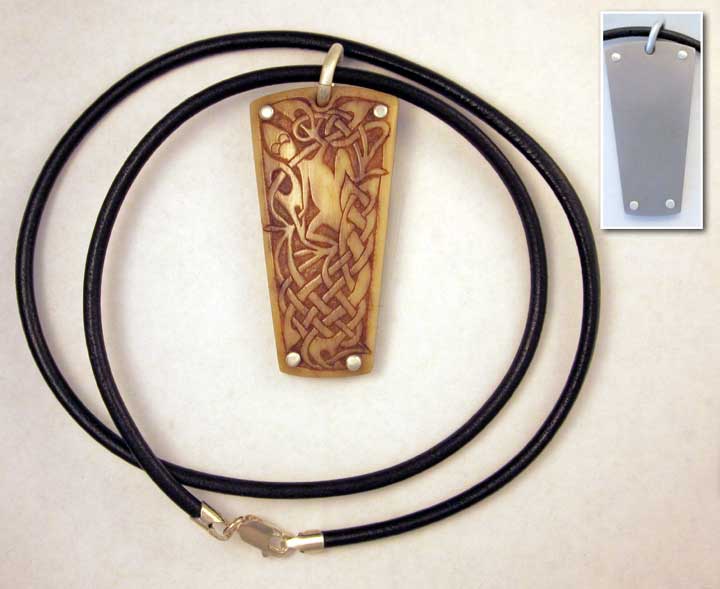
Well, engraving the tiny Orca knife in antler was so much fun, I just had to continue on in the same vein, so the Celtic Lizard pendant was born.  A little less than 2 inches tall, engraved and carved from naturally-shed elk antler, with a titanium backing and massive silver bail.

I aged the antler with potassium permanganate, and used cold connections to fasten the titanium backing to the antler with silver rivets.
Antler_Celtic_Lizard_Pendant_6aWeb

And, below, a larger detail picture.  Thanks for looking!
Antler_Celtic_Lizard_Pendant_6bWeb

Available soon at BladeGallery.com


Thanks for Looking!


Posted in Carving, Jewelry, Pendant | Tagged , , , , , , | Leave a comment

“Have You Heard the Owl Call Your Name?” Art Basket

Here’s something my wife and I haven’t done for quite a long time, the “Have You Heard the Owl Call Your Name?” Art Basket.  When we first started our art careers, we collaborated on quite a few tiny little art basket loosely based on the Nantucket Lightship style of basketry  (see more of our past baskets here).  My wife produced the baskets and I decorated the lids.

Here, we’ve created this basket from black walnut, yellowheart, superfine carriage cane, copper, waxed Irish linen and naturally-shed moose antler.  The basket is about five inches in diameter.  The skull finial is one of my press-formed-then-chased copper owl skulls (more about that can be found here).

Have_You_Heard_the_Owl_Call_Your_Name_Basket.0

Thanks for looking!


Posted in Art Basket, Carving, Press Forming | Tagged , , , , , , , | Leave a comment