William Henry “Engraved Longhorn Beetle Knife” Part 5

William_Henry_B10_Longhorn_Beetle_34
William_Henry_B10_Longhorn_Beetle_35
Today is all about carving the bark.  Above, I’ve begun by using a small carbide bur to begin adding vertical development to my so far very flat bark.  Since the stainless steel scales aren’t terribly thick, I’ve chosen to cut away the top side and left side of each bark element (top and left seen as the image is oriented here).  That will leave the bottom edge and the right side at the original surface level.

William_Henry_B10_Longhorn_Beetle_36
Above

, I’ve come back with a smaller carbide bur and carved the top and left edges a bit deeper, and better defined the edges.  I want them to be fairly vertical.

William_Henry_B10_Longhorn_Beetle_38
Above, I followed up the tiny carbide bur with a much larger one.  I’ve done this to eliminate the tiny “scribbled” texture the tiny bur leaves.  The top image is unpatinated, and the lower image has had a quick patina added.  Notice how the patination really cuts the shine, and improves the appearance immensely.  It’s actually starting to look like bark now.

William_Henry_B10_Longhorn_Beetle_40
Of course, most tree bark has deep cracks separating the “elements.”  Above, I’ve come back with a Lindsay Detailing graver (96 degree V), followed by a small onglette to cut those deep lines.

William_Henry_B10_Longhorn_Beetle_41
The bark still looks too “defined” and sharp.  So, above, I’ve used a large and slightly rounded punch to “beat the bark into submission.”  You can see the face of the punch in the image.  I’ve also textured the face of the punch by hammering it lightly into a 600 grit diamond lap.  This grips the stainless steel better, causing it to move more efficiently, and leaves behind a nice, dull surface.  I’ve also concentrated on the edges of the bark elements to slightly round them over, and lower the very flat bottom and right edges in spots.

William_Henry_B10_Longhorn_Beetle_42
Above, this is a far as I’ll go today.  The two large areas with the original surface will end up as bark eventually, but I need to inlay the beetle antennae in gold first, followed by carving away the bark up to the edge of the gold inlays.

Thanks for looking!

Posted in Carving, Engraved Knife, William Henry knife | Tagged , , , , , , , | Leave a comment

William Henry “Engraved Longhorn Beetle Knife” Part 4

William_Henry_B10_Longhorn_Beetle_29
Today, I carved the rotten wood at the back end of the scale.  Above, you can see the basic carving with small carbide burs.  The only direct engraving I’ve done at this point are the original cuts I made at the start, establishing an indelible pattern.

William_Henry_B10_Longhorn_Beetle_30
Above is the finished wood and knothole, both in the plain steel from the gravers and burs (top image) and after using my super-secret stainless steel patination process (Jax Silver Blackener, followed by Birchwood Casey Super Blue).

William_Henry_B10_Longhorn_Beetle_31
But, I’m not completely pleased with the rotting wood yet.  In the top image above, I’ve circled the area that I don’t like.  It just seems a little overworked, and the bottom edge looks more like a copy of the top edge.  In the image below, I’ve gone back and fixed that!  Much improved.

William_Henry_B10_Longhorn_Beetle_32
So , that’s enough for today.  Above, you can see where I got to, completing the right side of the beetle legs, and carving the rotten wood at the rear.

Thanks for looking!

Posted in Carving, Engraved Knife, William Henry knife | Tagged , , , , , , , | Leave a comment

William Henry “Engraved Longhorn Beetle Knife” Part 3

William_Henry_B10_Longhorn_Beetle_22
Time to begin carving the beetle.  I started by engraving parallel cuts between the legs

, leaving a little metal at the edge of the inlay pocket.  I don’t want to cut into the pocket and weaken the grip on the shibuichi.

William_Henry_B10_Longhorn_Beetle_24
Above, I used carbide burs to cut down to the bottom of the parallel cuts, followed by a punch (between the blue arrows) to further drive the raised metal down and in to the inlay pocket.  Since I wasn’t certain how this might work out, I worked on a single small section – part of my policy of Graceful Degradation.  However, luck was with me and the technique worked flawlessly!

William_Henry_B10_Longhorn_Beetle_25
Above, I’ve continued the series of parallel engraved cuts all around the shibuichi beetle body, leaving the narrow ridge of steel all the way around the edge of the inlay pocket.

William_Henry_B10_Longhorn_Beetle_26
Above, I’ve cut away the waste steel surface around the legs with carbide burs, and used the punch to drive the ridge further down into the shibuichi and inlay pocket along the left side.  I’ve used a tiny flat graver to further refine the edges of the legs and the surrounding steel surface – you can see the little “roadlike” tracks left by the flat graver.  I’ll use a tiny carbide bur to disguise the smooth “road,” followed by a tiny onglette graver to cut a small groove at the base of each leg and steel surface, and then use the punch to gently sculpt the upper surfaces of the legs. The sculpting will take the legs from tiny, blocky/square ridges to rounded and elegantly curved surfaces.  All the boy beetles will sit up and take notice when she slinks by…..

William_Henry_B10_Longhorn_Beetle_28
I’ve tried another experiment, and stippled the left side of the steel surface around the beetle body and legs to darken the area like a shadow, and added a quick patina.  I couldn’t resist seeing how it will turn out down the road!

Thanks for looking!


Posted in Carving, Engraved Knife, William Henry knife | Tagged , , , , , , | Leave a comment

William Henry “Engraved Longhorn Beetle Knife” Part 2

Installing the Shibuichi Pocket Inlay

Today is all about getting the shibuichi inlay into the stainless steel scales.  As far as I’m concerned, this is the make it or break it phase.  If I should fail to get the inlay properly in place, that is probably the end of this knife scale.  There might be a second chance if I’m lucky, but even that would entail a LOT of extra work, so this is a very worrisome time.

William_Henry_B10_Longhorn_Beetle_15
Once the pocket was of sufficient depth and fit (side to side), I once again undercut the bottom edge, and then cut in a forest of tiny “hooks.”  Using a flat graver, I cut parallel lines running the length of the pocket, and then went back at 45 degrees and cut a second set of rows.  This left lots of tiny hooks on the bottom that the shibuichi beetle will catch not, helping to hold the inlay into place.  For a more in-depth look at cutting these hooks, take a look at my “Beneath the Blood Moon” Pendant.

William_Henry_B10_Longhorn_Beetle_16
I’ve annealed the shibuichi beetle once again, to ensure it is as soft as I can get it.  Above, I’ve used a small lead block and small hammer to seat the shibuichi inlay firmly into place. This little lead block works really well to provide a “dead blow” action, without marring the shibuichi inlay, causing the little hooks to dig into the shibuichi, and force the bottom of the shibuichi into good contact with the bottom of the inlay pocket, just in case it isn’t completely flat.  This little lead block hint comes courtesy of Ford Hallam, and you can see it in action in Part 1 (at 11:40) of his film Utsushi – In Search of Katsuhira’s Tiger  Be certain and watch Part 2 as well, it’s well worth the time.

William_Henry_B10_Longhorn_Beetle_17
Here’s a view from the side – notice the raised edges of the steel around the inlay.

William_Henry_B10_Longhorn_Beetle_18
Above, a view under the microscope.  I’ve used the punch you see in the photo to begin punching down the raised steel edges of the inlay pocket – I started at the top (between the two blue arrows), then moved to the bottom between the two blue arrows.  This locked the shibuichi into place in the center of the inlay pocket, so I could continue on around and punch down the rest of the raised edges down.

William_Henry_B10_Longhorn_Beetle_19
Above, I’ve finished punching down the edges.  The shibuichi is now completely locked into place.  To remove this inlay now would require destroying the inlay, or the scales, or both.

William_Henry_B10_Longhorn_Beetle_21
And, above, just because I wanted to before I stop for the day , I’ve used a carbide bur to roughly carve the beetle body to shape.

Thanks for looking!

Posted in Carving, Engraved Knife, William Henry knife | Tagged , , , , , , , | Leave a comment

William Henry “Engraved Longhorn Beetle Knife” Part 1

Well, after finishing up the little copper overlay titanium owl pendant, I’m back into the swing of things to begin my next William Henry (www.williamhenry.com) commission, a small B10 model folding knife.

William_Henry_B10_Longhorn_Beetle_1
I started by engraving the basic layout of the beetle legs, the bark and knothole on the nicely machined 416 stainless steel scale, and super glued the shibuichi beetle body to the surface so I could carefully trace around it with a small, sharp scribe.  Two tiny drops of thick, gap filling super glue suffice, and the beetle can be easily removed with a small wooden punch, tapping on the side of the beetle.  The glue will vanish when I anneal the shibuichi.

William_Henry_B10_Longhorn_Beetle_2
Above, I’ve carefully used a Lindsay Detailing engraver (96 degree V graver) to cut inside the scribed lines around the beetle’s body.  I need to excavate a pocket to inlay the shibuichi body into the steel scale.  This type of inlay is held in mechanically, and no glue or solder is used.

William_Henry_B10_Longhorn_Beetle_3
Next, I need to begin excavating the “pocket” for the shibuichi beetle to fit into.  I start that process by engraving parallel cuts along the length of the body pocket.

William_Henry_B10_Longhorn_Beetle_5
The parallel cuts will aid me in keeping the bottom of the pocket flat.  Above, I’ve used a small carbide ball bur in my NSK Electer micromotor grinder to begin cutting away the waste metal.  I cut to the bottom of the grooves.

William_Henry_B10_Longhorn_Beetle_6
Above, I’ve finished excavating the pocket.  You can still see a bit of the engraved line bottoms left at the bottom.

William_Henry_B10_Longhorn_Beetle_7
I’ve used the same 96 degree graver to cut deeper around the edges.  I’ve carefully tipped the graver so the outside edges of the pocket will be close to 90 degrees (vertical).  I’ve also begun the process of engraving more parallel cuts.  I have to be especially careful now, since the bottom of the pocket is getting deep enough that I might scar the edges of the front or back ends – this is sometimes called a heel strike in engraving.

William_Henry_B10_Longhorn_Beetle_8
And, above, I’ve completed engraving the second set of parallel cuts, ready to use the small carbide bur to excavate to the bottom of the engraved cuts.  I’ll repeat this parallel cuts/carbide bur excavating process one more time to achieve the depth I need.

William_Henry_B10_Longhorn_Beetle_9
Above, the pocket is completely excavated.  I’ll use a flat graver to undercut the edges of the side walls – I simply press the flat graver straight into the bottom edge, cutting a gap below the vertical walls.  I need this small gap to make the next step easier – using several different punches to “forge” the walls in order to raise the outside edges up, and out.  This will provide enough extra room so the shibuichi beetle body will fit into the pocket.  As the pocket is right now it is too small for the shibuichi body.  There is a little madness to my method – the raised outside edges will provide enough extra steel to mechanically hold the shibuichi inlay in place when I use a punch to drive the raised edges down, hopefully actually denting into the shibuichi for a super-strong hold.

William_Henry_B10_Longhorn_Beetle_11
Here, above, is the inlay dropped into place, with very little clearance around the edges.  Tomorrow, I’ll cut a bur field in the bottom of the pocket, and then set the shibuichi in permanently.  If all goes well, the only way to remove the inlay will be to destroy it, or the scale.

William_Henry_B10_Longhorn_Beetle_12 William_Henry_B10_Longhorn_Beetle_13
Above

, a couple of side views of the inlay just set into place.

Thanks for looking!

Posted in Carving, Engraved Knife, William Henry knife | Tagged , , , | Leave a comment

The “Alchemy” Locket

Amanda_Alchemy_Locket_1_Web
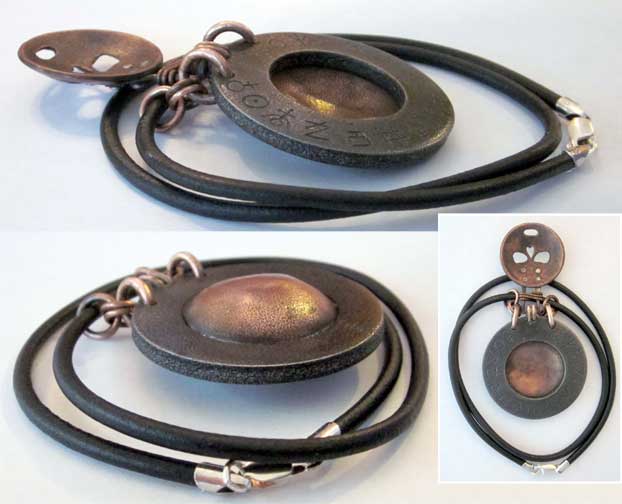
I forgot I made this necklace for my daughter a couple of years ago, and she says she gets all sorts of compliments whenever she wears it.  This was made from a steal washer from the local hardware store, copper, and a dash of silver for the rivets.  The diameter is 1.75 inches in diameter and hangs on an 18 inch leather cord that sits the medallion just under the collarbone.

The symbols carved into the washer are alchemical sigils that give the locket an air of mystique and magic, while the grotesque throws in a hint of violence.  Definitely a conversation piece, and follows my “ugly/weird horror” theme that tells a story.  The mechanical hinge is also reminiscent of the steampunk style that is popular right now , combining the old with the new for a fractured fairytale feel.

Amanda_Alchemy_Locket_4_Web

Posted in Carving, Jewelry, Pendant | Tagged , , , , , | Leave a comment

“Beneath the Blood Moon” Pendant

Making a Copper Overlay

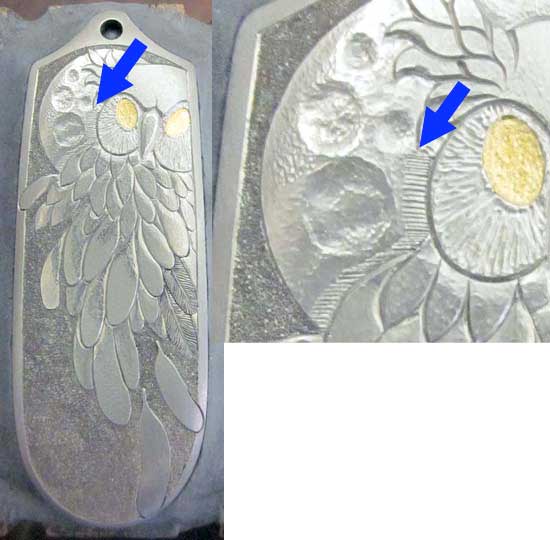
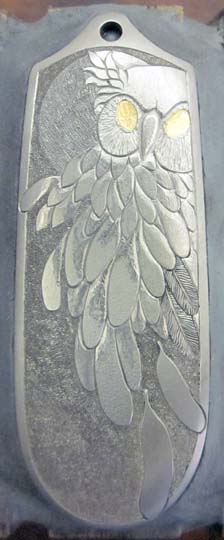
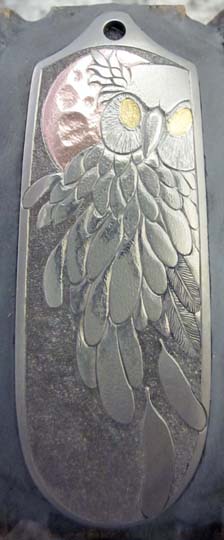
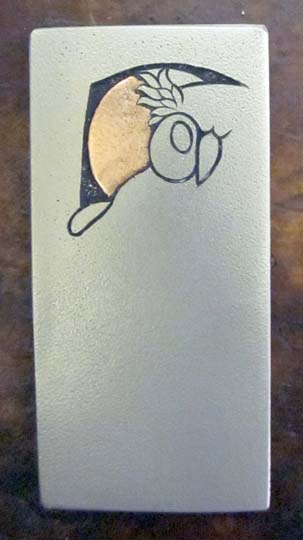
I’ve been away from engraving for a few weeks, and I decided I needed to practice up a bit before starting on a knife commission.  This is an extension of a knife design I intend to engrave in a few weeks, and I thought it would make both a nice pendant, and be a good practice piece to get my hand back into the swing of things.  I decided the moon behind the owl’s face would look good in copper and make a nice contrast to the grey of the titanium pendant.  Incidentally, this pendant is about 2 1/4 inches tall (about 57 mm).

Blood_Moon_Overlay_31
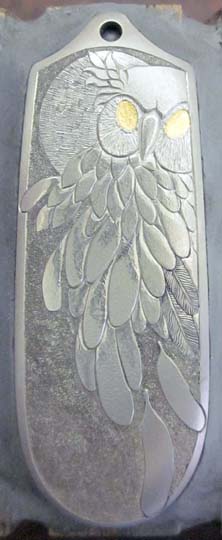
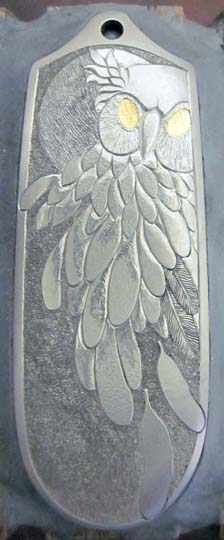
Above is the finished pendant, in Grade 2 titanium, copper, and 24 karat gold, with silver hardware.

Blood_Moon_Overlay_3
Above is a copper overlay practice piece for the practice piece, and my very first overlay!  Overlays are actually pretty simple in concept, but take a bit of practice to get right.  One simply makes an entire forest of tiny, sharp hooks in the parent metal, and then pound a softer metal down into those hooks.  If you’ve done it right, the little hooks will sink into the softer overlay metal, and then bend over, trapping the overlay.  Unlike inlays, overlays sit on top of the parent metal, where inlays continue down below the surface.  Overlays are best used for light duty items which won’t get a lot of abuse.  Overlays might not be the best thing for engraved firearms, where the pounding shock caused by shooting might loosen them.

Blood_Moon_Overlay_5A
Above, I’ve indicated how I begin to make my forest of tiny hooks.  Using a flat graver, I cut lots of parallel lines, holding the graver at about 45 degrees to the surface of the metal. When I’ve cut parallel lines all across the surface to be overlaid, I then change direction by about 45 degrees and cut more parallel lines.  I did this for three successive layers, and was able to get the overlay to stick quite nicely.

Blood_Moon_Overlay_1
Above, I’ve prepared the surface of the moon by cutting it lower than the surface of the owl face, and added several shallow craters.  Now, I’m ready to begin cutting the tiny forest of hooks.

Blood_Moon_Overlay_4
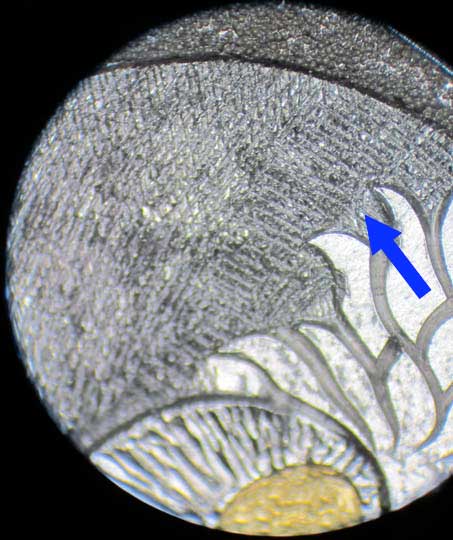
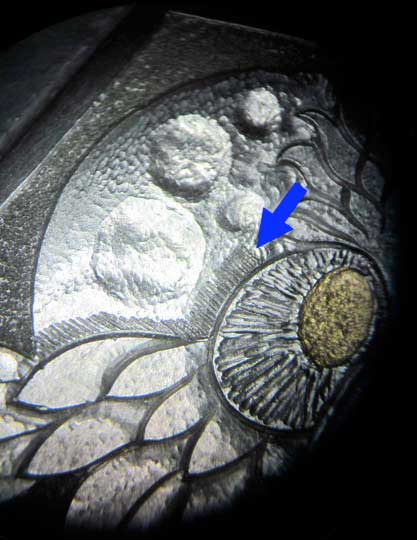
Above, you can see where I’ve begun cutting the parallel line cuts, using a small flat graver.  I’m cutting from top to bottom, starting at the blue arrow.

Blood_Moon_Overlay_5
Another view of the first row of cuts, above.

Blood_Moon_Overlay_6
Here, I’ve finished covering the entire surface of the moos with parallel cuts, raising a small bur each time.  It feels about as rough as a fingernail file.

Blood_Moon_Overlay_7 Blood_Moon_Overlay_8
Above, a more magnified view, and the entire pendant at this point.

Blood_Moon_Overlay_10
Here I’ve begun the second layer of cuts, at 45 degrees to the first group.  I’m careful to cut AGAINST the raised burs of the first layer – our aim is to raise lots of burs, not knock them down.  I’ve started at the blue arrow, and worked down.

Blood_Moon_Overlay_11
A more magnified view.

Blood_Moon_Overlay_12
And, above, the entire surface finished with the second layer of cuts.  It is now so rough, you can sand bits of skin off with it.

Blood_Moon_Overlay_13
Above, the overall view of the second layer.

Blood_Moon_Overlay_14
Now for the last (third) layer.  These end up perpendicular to the first layer.  It is difficult to see these as lines of cuts, because they are beginning to become lots and lots of individual burs.

Blood_Moon_Overlay_15
A more magnified view of the beginning of the third layer.

Blood_Moon_Overlay_16
Above, the entire third layer completed.

Blood_Moon_Overlay_17
And, above, the entire pendant view.  We’re ready to add the copper foil overlay at this point.

Blood_Moon_Overlay_18
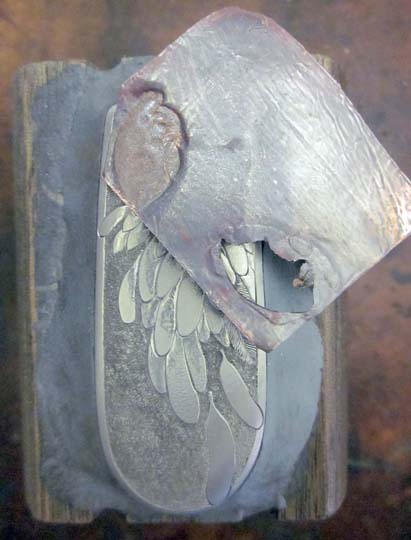
Above, I’ve used a brass punch to drive 1.25 mil copper foil into the forest of hooks.  I used a smaller brass punch to get into the tight spots.  Note that I’ve carefully annealed the copper foil to make it as soft as possible, and cleaned most of the scale off.  If you’ve done the forest of hooks correctly, the foil should stick quite easily.  If not, you’ve done something wrong……..By the way, this copper foil is the kind used for stained glass.  This stuff had a self adhesive film on it, but it burned away just fine when I annealed the copper.

Blood_Moon_Overlay_19
And, above, an overall view.  I’ll use a sharp scalpel to carefully cut around the edge of the moon and cut away the extra foil.  I’m careful to cut away from the edges, so I don’t inadvertently pull up an edge of copper.

Blood_Moon_Overlay_20
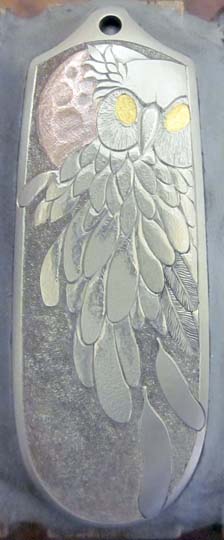
Once I had the extra copper removed

, I used a steel punch to really force the copper into the hooks, and bend them down as well, so the copper is really well trapped and secured.  I followed that with a little steel wool and burnishing with a carbide burnisher.

Blood_Moon_Overlay_21
Above, you can see the finished overlay and the three punches I used – two brass and one steel (made from a broken rotary bur).

Blood_Moon_Overlay_22
And, above, ready for detailed engraving.

For more information about overlays, try these excellent links by Sam Alfano:
http://www.igraver.com/gold_overlay/index.shtml
http://www.engraverscafe.com/showthread.php?1904-Gold-overlay-variation

Thanks for Looking!
Posted in Jewelry, Pendant | Tagged , , , , , | Leave a comment

“Homage to the Gator Gods” Art Basket

The making of “Homage to the Gator Gods” Art Basket

Recently, I was reminded of this little tutorial I posted on a carving forum back in 2007, and thought it would be nice to add it to the resources page.  We haven’t done one of these in a while, but it is great to remember the good time my wife and I had making it.  Click here to go there:  The making of “Homage to the Gator Gods” Art Basket

Gator_Gods_47Gator_Gods_46

Thanks for looking!

Posted in Art Basket, Carving | Tagged , , , , | Leave a comment

Thor’s Hammer – Mjolnir Pendant

I’ve been finishing up preparations for showing at the 1st Annual Seattle International Knife Show, and it turned out I had a few hours left over, so I decided to make a small Thor’s Hammer pendant in steel and silver

, with gold rune inlays.  All right, actually my wife sent me out to the studio to get me out of her hair…idle hands, you know…..  It’s 1 1/4 inches wide, and just under 2 inches tall, inluding the large silver ring with copper rivet.  Hope to see some of you at the knife show!

Thanks for looking!

Thor's_Hammer_Web

Posted in Jewelry, Pendant | Tagged , , , | Leave a comment

Dragonsbane Poniard – Part 10 – Finished

Thank goodness it’s finally finished!  The “Dragonsbane Poniard” is engraved and carved 1045 carbon steel, with 24 karat gold inlays, carved copper crossguard, 22 inches overall length, and a huge pain to carve and engrave. This was one of those projects that gets more abandoned than finished! Remind me not to do another really large dagger like this. Or any really large engraved knife. Really. ‘Cause I’m likely to do something insane like this again. It’s just my way… Help. Please stop me…

Dragonsbane_Poniard_75 Dragonsbane_Poniard_77 Dragonsbane_Poniard_79

Thanks for looking!
And come see this dagger (and me) at the 1st Annual Seattle International Knife Show this weekend (April 26th and 27th , 2014) in Kirkland WA.  Looking forward to seeing you there!
 

Posted in Carving, Engraved Knife, Misericordia | Tagged , , , , , , | Leave a comment